By Mark Asch
Photos by iO Tillett Wright
Olivia Thirlby is “nowhere near a vegan.” But we’re sitting at a vegan restaurant in the East Village because she loves their shitake mushroom burger (when the waitress tries to take away her plate, she tells her, “I’m actually still eating this, there are pickles”). She also gets a kale, spinach, chard, broccoli and carrot juice for her mother, who texts her during the meal, requesting that she bring one home when she’s finished.
Thirlby, who lives in Los Angeles now after two years in Williamsburg, and a “shoebox” in the West Village before that, grew up nearby, in Alphabet City. She went to Friends Seminary, the small Quaker school in Gramercy, where “everyone who auditions to be in the play gets a part, everyone who tries out for the soccer team gets on the team.” That formative atmosphere may explain why she comes off somewhat looser than you’d expect from someone who began appearing in films shortly after graduating from a New York City private school.
Thirlby was a bright, engaging presence in notable late-aughts indies—she was Ellen Page’s teen-girl-overdrive BFF in Juno, and respectively city-kid savvy and endearingly tentative as the high school crush objects in The Wackness and David Gordon Green’s Snow Angels—and she did some quality television, playing the put-together paragon of sensibility who moves out of Jason Schwartzman’s Fort Greene apartment in the first episode of Bored to Death. Now, having spent much of the last two years banking blockbusters and prestige dramas, she’s reemerging on screens, beginning in December with the 3D alien-invasion thriller The Darkest Hour and continuing next year with the adaptation of poet Nick Flynn’s memoir Another Bullshit Night in Suck City.
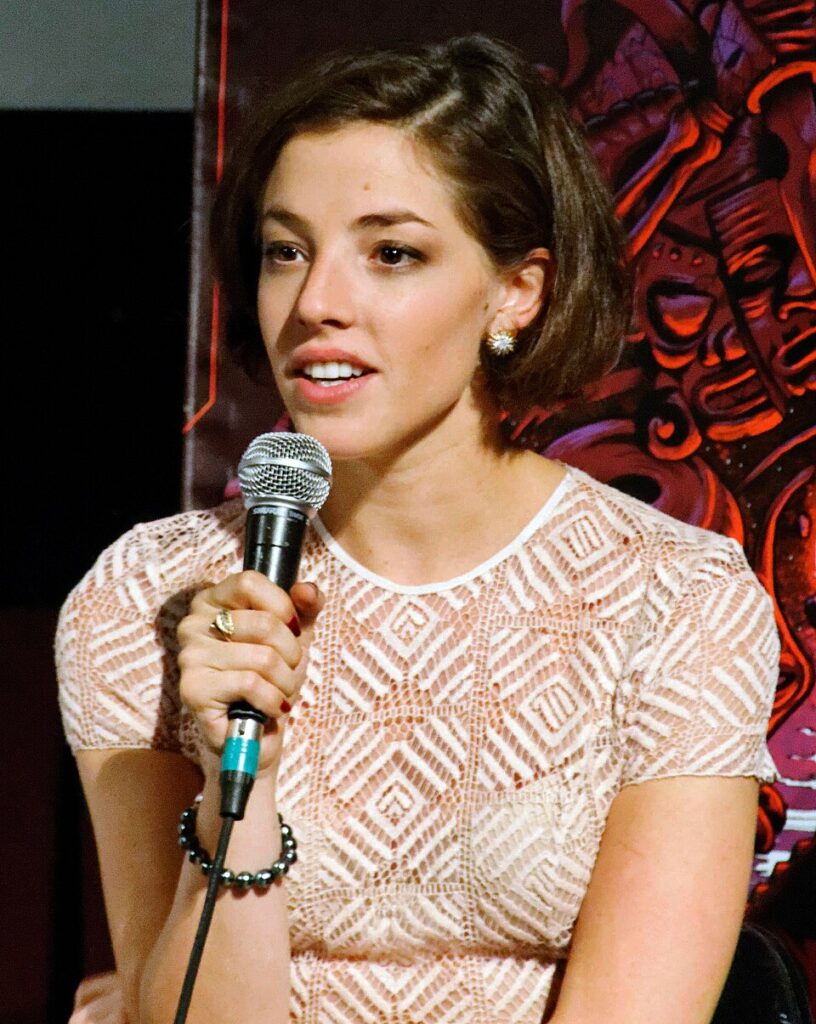
And in the meantime, as you can see, she’s cut her hair. “It came off in stages,” she explains. “A year ago it was still long and dark and was about to be dyed blonde and cut shoulder length, which happened. And then after that it kind of went into a dark bob, and then after that it went all the way off. And that was in May.” It’s the first time it’s been this short “since, you know, baby-dom.” Thirlby has strong 1940s eyebrows and her jaw narrows to a small chin around a wide mouth, so that even when she’s relatively subdued, as she is during our lunch—she’s been traveling, and catching up with friends in the city—her expressions take up more of her face than they would of yours. She’s frequently been cast in reactive roles—love interest, sister, sidekick—though who knows whether that’s due to her natural responsiveness, the dearth of true leading parts for young actresses, choice, or chance. “I decided at a certain point,” she says of her rise up the Hollywood depth chart, “that I was going to be open to absolutely everything that came my way. And promptly following that decision a lot of crazy opportunities threw themselves at me.” Her goal, she’s decided, is “a career that makes me genuinely happy at every single stage of the way, and that’s really hard to do.”
Thirlby can be disarmingly frank about that career. Told that her debut film, The Secret—a domestic thriller with some Elektra Complex frisson, starring David Duchovny as a widower whose teen daughter, Thirlby, is possessed by the soul of his late wife, her mother—is now on Netflix Instant, she gives her arm a sarcastic drum-majorette swing and says, “Well, great.” Thirlby doesn’t like to watch her old movies in general: “It’s two-pronged terrifying. One reason it’s terrifying is that you’re forced to confront your own aging, which is combined also with your own childish ignorance, which you just see, glaring at you. And then the other side is, ‘Oh, but look at my skin.’ And then, the other reason it’s terrifying is because that is inherent in the nature of what I do… which is that me, living in my own moment, gets turned into something that people can watch, forever. And that’s really terrifying. So I actually try not to ever grasp that fully. Otherwise I wouldn’t do what I do.”
Many of Thirlby’s early roles, in indies with East Coast coordinates, languished—like her second film, Kenneth Lonergan’s post-9/11 panorama Margaret, released this fall after five years of recuts and legal disputes—but enough caught on that critics began to take notice. In 2008, Thirlby was profiled briefly in New York magazine, and confessed to her interviewer, “I wish I lived in Bushwick and was paying $650 a month for a crappy sublet.” She moved to a loft on Lorimer Street later that year. When she first moved there, having been “converted” by earlier adaptors, she appreciated “the fact that at one o’clock on a Saturday you could go eat brunch somewhere, and not have to wait in a line”; she has fond memories of Le Barricou, on Grand, and the since-shuttered Baba, on Lorimer (cross street either Ainslie or Powers, she always forgets the order after Devoe). She was happy, she says, to walk around the old neighborhood for this feature with her friend, the photographer iO Tillett Wright, which is another thing she liked about the neighborhood: “I was surrounded by a lot of really interesting people—some of whom I was lucky enough to actually meet.” (Even her Los Angeles friends are moving to Bushwick now.) And “geeky hipster” stuff, like having “the best tattoo artist in the world,” Scott Campbell, right around the corner.
Thirlby has several discreet tattoos on her upper arms, and a small ampersand above her right elbow, “my first tattoo in black ink,” which matches the tattoo of a close friend who “coerced me into making a commitment.” The ampersand, partly inspired by a line in the Magnetic Fields song “I Don’t Believe You,” symbolizes “placing emphasis on the forward-facing trajectory of time, and how each moment is followed by another moment that is potentially as potent, or is necessarily as potent, as the one preceding it.”
Thirlby took the subway to work when she was living in Williamsburg and shooting Bored to Death, which she found to be “a really lovely overlap” between New York City life (which involves not infrequent film shoots in one’s neighborhood, at that) and dream life. Bored to Death, lighthearted as it is, means something to Brooklynites unaccustomed to seeing their immediate environs (Hey, that coffee shop is Smooch! Hey, that’s a La Strada song on the soundtrack!) represented accurately in the mass media, which Thirlby appreciates, though she reserves her proprietary hometown pride for neighborhoods themselves: “I have a very good amount of native snobiness; I like to preach about how much the East Village has changed. And Williamsburg too, but I guess I can’t… but even then, in 2008, Bedford Avenue was still very much like Williamsburg.”
Being a lifelong New Yorker is also why she left: “Everyone must have the opportunity or create the opportunity to live somewhere other than where they’ve grown up. There’s sometimes an overwhelming familiarity here that is almost unpleasant, just because every place I might go evokes some memory of a former life there.” She misses her family and friends, though she appreciates the mobility afforded by her job, and Los Angeles, where “we’re in a little bubble which consists of your own house and your own car and your own pace,” nicely complements NYC, “once you get over hating LA so much.”
Thirlby picked up stakes for Los Angeles last year, though she spent much of 2010 on the road. She went to Antarctica to shoot an experimental film (The Red Knot, by the artist Scott Cohen) on an ice breaker, to Cape Town for the upcoming Dredd, and Moscow, for three months, for The Darkest Hour. “I just got to live in a really, really different, really foreign city for three months, and I was working my ass off, but you can’t help but pick up where you are.” It’s her favorite perk of the job: “It’s pretty awesome to be able to travel and actually come out financially on top.”
For films like The Darkest Hour, Thirlby allows that “the dominant part of what you have to get down on camera is not based on being in touch with the truest of human emotions. Run from the alien or the alien will shred you into dust. It’s a simple emotion but at the same time there’s nothing in my life that I can relate to about that, so it requires a lot of imagination, and it can be really challenging to sustain yourself on imagination alone. But it’s also kind of the coolest part at the same time.” Still, even playing “the girl in the horror movie,” she prefers to “concoct almost every detail, just because it allows ease with improvisation.”
For Being Flynn—as the adaptation of Another Bullshit Night in Suck City has been retitled—backstory was especially important, because her character “has this troubled past, which she actively hides from all the people around her. So that was kind of an interesting thing to play around with, knowing that the way that she conducts herself in the world is with a mask on.” She plays Paul Dano’s love interest, who encourages him to start working in a homeless shelter—another good-listener role. For Thirlby, “if you’re able to listen, truly listen to someone in a moment, you’re able to react naturally and that can be just as therapeutic” as a personal connection to the material; acting can be a reminder, like her ampersand tattoo, of her moment in the universe, and the feeling is “elating—is that a word?”
Acting on stage—where, unlike the choppy filmmaking process, her abandonment in the moment is continuous, and there’s no permanent record of her past self—is, Thirlby says, what she finds most elating (it’s in spellcheck and everything). She was in the Atlantic Theater Company’s production of Beau Willimon’s Farragut North (in the film version, Ides of March, the role is played by Evan Rachel Wood), but it’s been a couple of years since she’s been on stage “and that is just a sad, sad tale.” Moving to Los Angeles from New York, she acknowledges, isn’t exactly an ideal strategy for building a career in the legit theater—at this point, she leans into my voice recorder and announces, “Theater directors! Please offer me jobs! Or: I’ll audition!” Live theater was very much a part of her upbringing; she cites Christopher Plummer’s Lear, which she saw at Lincoln Center as a high school student, as a signal experience.
Another point of entry into the holy moment can be friendship: one Sunday while Thirlby was living in the West Village, she went over to her friend and neighbor Daryl Wein’s apartment to shoot a couple of scenes for Breaking Upwards, the 2009 feature he directed and cowrote and costarred in with his girlfriend Zoe Lister-Jones. “If you’re comfortable, and you love and admire the people around you,” it’s the best, most organic kind of preparation. For this profile, she appreciated the opportunity to be photographed by her friend, iO, “to run around and do what we would have done anyway,” while wearing her own clothes. That’s new for her, and nice—“they always dress you, they always style you… it’s part of playing the game.”
In a reversal of the usual formulation made by creative young people, Thirlby says she feels fortunate to have, with acting, “a real-world money-making career that will maybe afford me the luxury to be able to study other things with my brain.” She doesn’t regret not going to college, she says quite sensibly, “because the things I would really like to study now are wholly different than the things I would have studied when I was 18 or 19 or 20.” Lately, she’s sat in on a few of a friend’s classes at the College of the Atlantic, the school on the coast of Maine with only one major, Human Ecology. She’s interested in Eastern philosophy, and its familiar manifestations like yoga, and in the time she’s been back in the city she’s been down to Zuccotti Park a couple of times. A friend of hers started Occupy Venice Beach, and she and her mother have walked around Occupy Wall Street, on the drizzly slow days, having casual conversations. They plan to return later today; their joke is that they can’t get arrested, because they’re also doing a yoga class together at six. Thirlby’s taken with the potential, which she sees in the Occupy movement, of communities of interest beginning to form, however embryonically: “We’re human beings, and that is a powerful thing, to be a human being. I think we’ve kind of forgotten. We’ve just become consumers and we’ve forgotten that we’re… living creatures.”
A sense of shared humanity—an interest in human ecology, maybe—is also what animates Thirlby when the subject turns to the last time she was photographed by iO Tillett Wright. iO’s ongoing “Self Evident Truths” series is an ever-expanding album of black-and-white portraits of “anyone who’s anything other than one hundred percent straight,” and, implicitly, a plea for legal recognition of their equality. On SelfEvidentProject.com, Thirlby is there—alongside a coworker of mine at this magazine, her girlfriend, and many others—in the first batch of New York-based photos, her hair in its dark bob phase under a gray hoodie.
“When she told me about this project,” Thirlby recalls, “she asked me if I wanted to be a part of it and I did have to think about it for a minute. But ultimately I decided that absolutely yes I did want to be a part of this. It’s important for a lot of reasons. For me personally it’s important to be a part of this because I feel it’s a way of me showing gratitude that I live surrounded by a community in which I don’t have to hide my sexual orientation. And no one should have to hide their sexual orientation. Loving people is a necessary part of being human, and it is very difficult to love people in secret. It is a horrible thing to force people to do. And I am not one hundred percent straight—”
I’m not going to ask you to draw me like a pie chart or anything—
“—I mean there isn’t even a way that I could draw you a pie chart… I have a boyfriend, at the moment. But I appreciate the way that she’s going about doing this, and I so believe in the cause. Gay rights have always been a really big thing for me. I think growing up, especially in a theater community, I inevitably ended up having a lot of friends who are gay men. I now embrace the term ‘faggot,’ but I used to be that girl who would scream at you for using it. I’ve realized now that the best way to fight it is just to embrace it. This is a cause that’s really important to me and I guess this is my first way of taking a step. And it’s really special to be able to do it with someone who’s a friend, someone who’s work I already believe in so strongly. I agree with her, it is the Civil Rights fight of this generation. But I’m so lucky to have a job where it’s ok for me to not be in the closet.
And everybody needs to have that. Everybody needs to have that. Otherwise you’re depriving people of one of the most, if not the most essential, part not only of being human, but of participating in society. You can’t find love if you have to be secret about it. You’re not just depriving people of the ability to work in an office or be part of the military by depriving people the ability to be open about their sexual orientation. To tell people that who they’re inclined to love is grounds for being discriminated against… People who actually believe there is something wrong with love have their eyes willfully shut.”