INTERVIEW BY MARK MARTIN
PHOTOS BY JESSICA YATROFSKY
PHOTO ASSISTANT: BOBBY DAVIDSON / STYLING: EVREN CATLIN / STYLIST’S ASSISTANT: SHERRY WANG /MAKE-UP: TALIA SHOBROOK / HAIR: ANTHONY CAMPBELL
In almost everything written about Emily Mortimer, the observation that occurs time and again is that she is, above all, self-effacing. This trait is normally linked to her being terribly English. Before I have even met her, these conjoined notions are starting to gall. And not necessarily because they are untrue.
A fellow Brit, I am happy to concede that modesty is a national pastime. As to Emily, throughout our interview she exhibits a reassuringly unassuming demeanor for an actress of her luminosity. From the moment I persuade her to let me buy lunch—arguing, uncertainly, that the magazine will cover it—to the moment I say goodbye, somewhat star-struck and consequently failing to pay at all, she is constantly pulling the rug from under her own feet. Still, the question persists: How can this alumna of movies by Woody Allen and Martin Scorsese, who will this year star alongside Johnny Depp and Ben Kingsley (Hugo Cabret), Paul Rudd (Our Idiot Brother) and Owen Wilson (Cars 2), persist in the idea that she is insignificant? Isn’t effacing one’s self a form of concealment, of deceit even?
“I feel like the self-effacing side of me is where I go when I’m not feeling comfortable,” she says, when the subject is broached. “I’ve done it recently in an audition where I had to improvise, and I’m so terrified of that. Anything that I associate with drama school makes me feel very inadequate, because I didn’t go to drama school. I didn’t train or anything.”
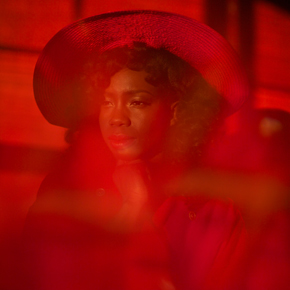
It’s worth noting something. In the course of our conversation, Emily has thus far insisted that she’s “lowbrow” while at the same time quoting Joseph Brodsky, and described her painful vacillations over whether to wear a favorite hat when about to be introduced to Woody Allen. During the photo shoot for this magazine, she endeared herself to the make-up artist and photographer with a stand-up riff on her sunburn. But when the subject of her modesty is addressed, she presents it as a tool she uses to get out of awkward situations. In other words, she is being self-effacing on the subject of her self-effacement.
Back to the story.
“I said, ‘I’m terrible at improvising, and you could see them all go…’” She pulls a face inspired by Edvard Munch. “I told them this story about an improvised comedy I was in called A Foreign Affair. I had to play a Russian bride, and I was thinking, ‘I don’t know how to improvise.’ There was a sort of script, and I was going to stick to that. So, we get out there and Tim [Blake Nelson, of O Brother, Where Art Thou?] asks my name, and I say, ‘Tatiana,’ in a bad Russian accent.” (Bad, no doubt, because she spent three years at Cambridge studying the language.) “Then he asks for my last name, and I don’t know… I’m trying mentally to flick through the script, and I’m thinking this is so unfair. Finally, there was this long pause, which ended with me panicking and saying, under my breath, in the most apologetic way, ‘Mortimer?’ And they yell, ‘CUT!’ I tell this story, but it’s not exactly going to inspire someone who’s making a really expensive movie to cast me.”
The story itself might not have vouched for Emily, but the endearing telling of it probably did. Was there a little bit of cunning in that? Whenever the label “self-effacing” is applied in the press, the implication is that what is described may be little more than an act, just one of innumerable ways to pose in the public eye. It’s a cynical notion that goes hand in hand with the assumption that Englishness is never more than an affectation, or a ruse designed to make the opponent drop his guard before being eviscerated by a line from Noel Coward. As the words pour from Emily in a disingenuous tumble, I discover what really annoys me about “self-effacing.” Isn’t it just the moral relativist’s word for honesty? Let’s face it: unless you’re Muhammad Ali, to be truthful is to be modest—and the love of unadorned truth is another trait that Emily identifies as particularly British.
“I’m always trying to work out where people are from, what their background is. To me it’s really interesting, trying to place people all the time. Like, how do you come to be? It’s fascinating. But it’s an English thing, to want to demystify.”
For Emily, who is indisputably posh, this interest in how people “come to be” developed during her teenage years into a love of popular British television—true entertainment for the masses. As the child of John Mortimer, a man famous in England both as a barrister and novelist, the mundanities of TV were exotic. “I got into showbiz from being a television addict,” she says, a habit that produced a number of déclassé symptoms. “Going somewhere in a caravan with Tupperware seemed like heaven. And I wanted that. I used to watch this thing called Summertime Special, from the Birmingham Exhibition Center, and it was just the most cheesy thing—dance troupes doing this sort of formation dancing, and band comedians, and I would long to be one of those dancers.”
It wasn’t to be. The nearest she got to becoming the “girl with an ankle bracelet” she dreamed of as a teen was probably Kenneth Branagh’s musical adaptation of Love’s Labours Lost. She wasn’t destined to be a showgirl. In the nicest way possible, she hasn’t the face for it. Her features suggest intelligent sympathy rather than gay abandon. The nose is blunted into an elegant little bulb; her eyes angled in an inverted V to express a state of perpetual empathy. It’s the elfin face of Galadriel’s bookish little sister.
How then did a career that once aimed so low launch itself in adaptations of Anthony Powell and Shakespeare? What went horribly right?
“When you first start off, you don’t turn down anything because it’d be daft. Then it gets to the point where you have to turn some things down because they’re not very good. But anything that’s good—it doesn’t matter what it is, a comedy or whatever—if you’re not embarrassed to be in it and you can do well in the part, you do it, because you’ve got to be working.”
It’s the natural-selection model of career development.
“You can make grand statements about your career choices, but it’s all in retrospect. At the time, it’s ‘I’d better just do this.’”
Without design, a typical Mortimer role has evolved. Such a thing exists, despite her having played Princess Di, a leather-clad assassin, and—this summer, in Cars 2—a Jaguar XJR-15. It’s a type best identified through a process of triangulation plotted from such known points as the naïve rich girl in Match Point, the actress with a secret in City Island, and Alec Baldwin’s girlfriend with avian bone syndrome on 30 Rock. Humor and a willingness to appear vulnerable are the common denominators. The roles, it seems, choose her, an idea she is less happy about with her next live-action movie: Our Idiot Brother, scheduled for release in August. Directed by Emily’s friend Jesse Peretz, it stars Paul Rudd as the eponymous dimwit, a sweet-natured hippie whose never-failing trust in humanity lands him in jail. On release, he falls into his sisters’ laps like a guileless hand grenade, bringing chaos and (no surprise here) becoming a catalyst for positive change in his family’s staid lives. Emily plays one of his sisters, a woman trapped in a failing marriage to a man played by Steve Coogan.
“I’ve just given birth to my second child and I live in a brownstone in Brooklyn and my husband isn’t behaving how he should be,” she says, sketching the character. “At the time, I had just had my second baby and I live in a brownstone in Brooklyn, and I felt slightly pissed off about that.”
But it’s the kind of mirroring between life and art that recurs in her life, which, to the casual observer, resembles a long string of happy accidents. Her father was a wit and an indulgent bon vivant, a great stimulus for a developing mind. As well as being a household name as a writer, he was counsel for the defense in a number of high-profile cases and once championed in court the use of the word “Bollocks” on the Sex Pistols’ first LP. She grew up in the Chilterns, a landscape as benign and cozy as a quilted bedspread. A film-industry fairy godmother spotted her in a student production. She met her husband (the American actor Alessandro Nivola) on the set of Love’s Labours Lost, and progressed rapidly from the merely brilliant Branagh to directors in the Jovian class. Even her decision to move to Brooklyn was taken at random but turned out for the best. “I knew nothing about Brooklyn when I moved here,” she says. “I might as well have stuck a pin in a map.” Initially a reluctant émigré, relocating to the US for her husband’s sake, she has since reconciled herself to an expatriate existence in the British ghetto that is Boerum Hill. In the ’hood, Building on Bond is her office; Rucola, a few doors from her home, the restaurant of choice.
On closer examination, this comic picaresque looks more like the workings of fate. Not in the mystical sense (a professed atheist, she’d have no truck with that), but fate defined simply as an accumulation of the past that comes to determine the future. Her father, her biggest influence, grew up wanting to be Fred Astaire. With a frame that soon mimicked Samuel Johnson’s, this was never a probable scenario, and, like his father before him, he took up law, eventually working out his creative juices in a slew of successful novels, TV scripts and plays. The best of the plays, the autobiographical A Voyage Round My Father, became a movie in which Emily’s grandfather Clifford is played by Laurence Olivier. At the end of the film, Olivier dies in the very bed where the real Clifford passed away, in the house where Emily grew up and where her mother still lives. With such an upbringing, becoming an accountant wasn’t an impossible contingency, but actress was much more likely.
In the future, she may pursue her father’s trade in writing. Since playing alongside Steve Coogan, she’s been gently piling on the pressure to persuade him to direct a script she wrote with a friend, based on a story by British writer Rachel Cusk. It’s an examination of a theme close to her heart: English people’s snobbery toward their transatlantic cousins—if the two can still claim to be family.
“In England,” she explains, “it’s wrong to be rude about different races or sexual preferences, but you can be rude about Americans. In fact, it’s weird not to be. Poor Americans! They love the British, and we do so well here by no virtue of our own, but only because, to them, we sound as if we must be more intelligent.”
Having done her part to ensure that no Brit will ever again be cast as a super-villain, she puts this English meanness down to jealousy. After all, American hegemony displaced the British Empire. But the snobbery she observes hints more generally at the dark side of the English sensibility. Beyond a certain point, the love of the unvarnished truth tips over into cynicism—which to the casual eye passes for honesty.
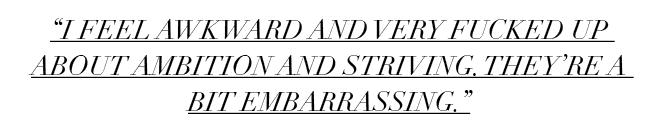
“I feel awkward and very fucked up about ambition and striving. They’re a bit embarrassing. It’s something innate to the British culture.”
Britons have always taken to expatriation, and Emily’s predicament helps explain why. It’s a culture in which people are meant to be defined and static—knowable—and if you want to change, it’s best to leave. And ambition, which is a desire for reinvention, is, in its early stages, indistinguishable from pretense, the worst of all sins to the English mindset. As Auden put it, to become anything, you first have to pretend to be it. No wonder he made his home in New York.
“It’s a great city to feel like you don’t belong,” she says. “Nobody really belongs and so we all belong.” •
Video unavailable.