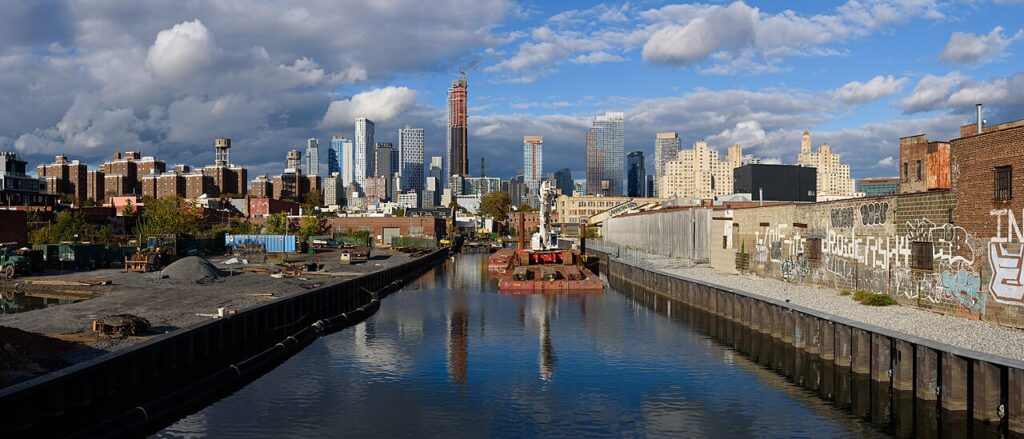
A photograph of the Gowanus Canal can offer several stories at once: water beneath a bridge, an industrial edge, a new facade, a narrow view of sky. The frame is compelling partly because it leaves so much outside it. It cannot show the condition of buried sediment, explain a sewer system or tell you whether a construction project has reached its final stage.
The magazine’s earlier Flora and Fauna of the Gowanus Canal and Its Environs belongs to a particular moment in the neighborhood’s cultural record. Reading it now can begin a conversation about attention to place. Understanding environmental change requires additional evidence, including dated material from the agencies responsible for the work.
Start with the waterway that was made
The city’s Department of Environmental Protection describes the Gowanus Canal’s development from a tidal creek and marshland into a dredged, straightened and bulkheaded industrial waterway. That history changes what a viewer is looking at. The canal is an engineered landscape whose visible form reflects decisions about movement, drainage and land use.
A waterway altered for industry cannot be understood through appearance alone. The shape of its banks, the surfaces draining toward it and the connections below street level all belong to the explanation. An attractive stretch of water may still sit within a much larger system. Looking beyond the frame begins by asking what flows into the place, not merely what can be seen from its edge.
Keep the environmental timeline separate from the skyline
EPA announced the canal’s placement on the Superfund National Priorities List in its March 2010 announcement. The announcement is useful as a dated record of that action. It is not a current completion report, and it does not describe the condition of every site in the surrounding neighborhood today.
Make a separate timeline for the question you are investigating. Environmental designation, selection of a remedy, construction activity and completion are distinct events. A building opening nearby does not establish that canal remediation has finished. Likewise, the presence of construction equipment does not, by itself, identify which part of the work is taking place or who is responsible for it.
Distinguish the canal bed from new inputs
DEP’s canal page distinguishes the sediment cleanup from work addressing combined sewer overflows. Its discussion describes dredging and capping the canal bed alongside measures intended to reduce sewage entering the waterway during rainstorms. These are related parts of the larger problem, but they work at different points in the system.
This distinction helps a reader make sense of updates that otherwise seem contradictory. An action addressing existing contamination and an action limiting new discharges need not proceed on the same schedule. A report about one should not automatically be used as evidence about the other. Before summarizing progress, identify the component being described and the geographic area to which the statement applies.
Read the date before the headline
Agency websites contain announcements, planning documents, environmental reviews and project summaries written for different purposes. Start with the document date and its stated scope. A rendering can explain a proposed arrangement. An environmental review can document an assessment. Neither should be described as a photograph of finished work simply because it appears on a current website.
DEP maintains a separate page for the combined sewer overflow facilities project and its environmental review materials. A reader comparing these with other records should keep the document types distinct. When a source gives an anticipated date, retain that wording rather than converting the expectation into a claim that the milestone occurred.
Use photographs for questions they can answer
Photographs are useful records of visible conditions. They can show the relationship of a bridge to a bank, the presence of a sign or a change in a facade. Record when and where an image was made, the direction of the view and any limits in what it shows. Repeating the same view over time can make those visible changes easier to compare.
A photograph cannot establish water quality or the safety of contact with canal water. Avoid attaching those conclusions to color, clarity, wildlife or a pleasant afternoon. Use the relevant agency’s current guidance and testing information for environmental questions. For this essay, the important reading habit is to identify the evidence a claim would require before treating an image as its proof.
Ask what a neighborhood story leaves outside its frame
A cultural account can be attentive to workshops, public spaces and the ways neighbors describe their surroundings. It can also overlook the people doing less visible work, or the residents whose experience does not fit the writer’s preferred picture. When reading an older feature, ask whose perspective is presented and which experiences would need another source.
The same question applies to a redevelopment image. A view designed to explain a proposal may say little about construction disruption, access or the daily life of nearby streets. Those subjects should be investigated directly. They cannot be supplied by assuming that every visible improvement has the same meaning for everyone who lives or works nearby.
Build a modest reading file
Keep a small record of what you have read: the source, its date, the area it addresses, the claim you are taking from it and the next question it raises. Separate direct observations from interpretation. If two documents use different boundaries or report on different phases, note that before deciding that one contradicts the other.
Preserve stable links when available and keep a copy of the document title. A browser tab labeled with the neighborhood’s name is easy to lose among similar results. Clear source notes make it possible to revisit a conclusion when a new update appears. They also prevent a short caption written months later from carrying more certainty than the original material supported.
Leave room for a place to remain unfinished
When a story makes a comparison, ask what the comparison measures. A newer photograph may use a different season, tide, camera position or field of view. A technical update may cover a longer interval than the caption beside it suggests. Put the two dates and the two subjects in the same sentence before deciding that they demonstrate a trend. Sometimes the honest result is that the materials describe different things.
That patience also matters when sharing neighborhood information. Link to the specific document behind a claim rather than sending readers to an agency homepage and asking them to find it again. Describe an open question as a question, and identify the office or project to which it belongs. A useful account gives the next reader a way to check the work, even when the writer cannot provide a final answer about a changing place.
Neighborhood writing often looks for a clean turning point: an industrial past giving way to a newly discovered future. Gowanus deserves more careful verbs. Some work may be planned, some underway and some documented as complete. A source may describe the canal, an adjoining parcel or a particular construction contract. Keeping those distinctions visible gives the reader a more useful account.
Read the older feature alongside the agency documents rather than asking either to replace the other. One can illuminate what a publication noticed; the others can explain the scope of specific public actions. More stories in Brooklyn and the Issue Archive offer additional cultural context. The most revealing view of the canal may begin with a photograph, then continue into the documents that show what the photograph cannot.
To compare a place across different records, begin with our approach to reading a Brooklyn block through old maps. These questions connect the canal to the wider neighborhood coverage at Brooklyn Magazine.